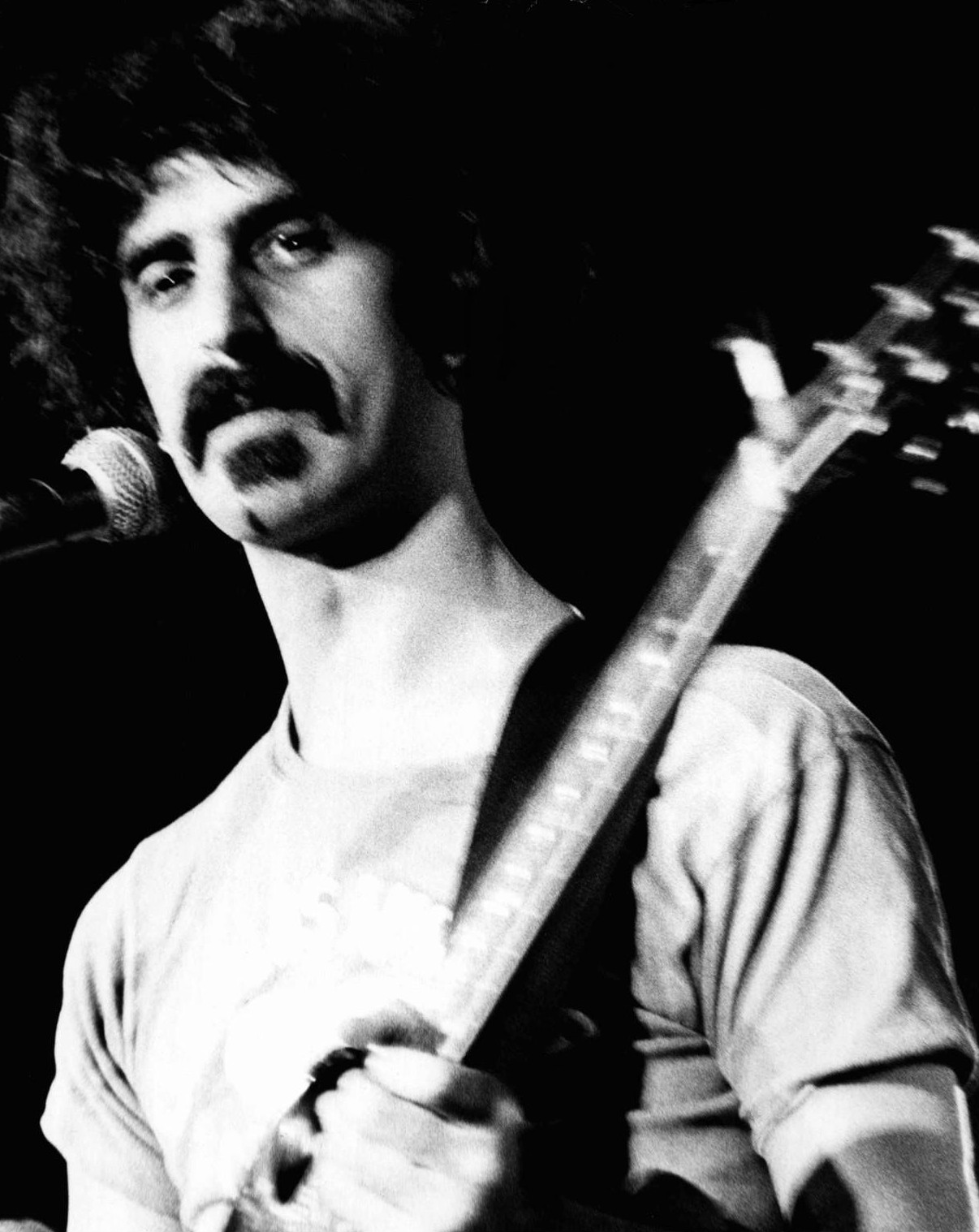
FrankZappa
The composer-satirist whose solos were spontaneous symphonies
Frank Zappa
The composer-satirist whose solos were spontaneous symphonies
Frank Vincent Zappa was born in Baltimore in 1940 and moved with his family to California as a child. A teenage fascination with the modernist composer Edgard Varèse sat alongside a love of R&B, doo-wop and blues guitarists, and he started out as a drummer before taking up guitar. In the early 1960s he scored low-budget films and ran a small recording studio in Cucamonga, where a police sting over a risqué tape he had made led to a short spell in jail.
In 1965 he took over an R&B bar band that became the Mothers of Invention, and their 1966 double album Freak Out! mixed satire, doo-wop parody and avant-garde collage. Records such as We're Only in It for the Money skewered both mainstream culture and the hippie scene. After breaking up the original Mothers in 1969 he released Hot Rats, a largely instrumental jazz-rock album built around extended guitar and violin solos, which first showcased Zappa as a serious lead guitarist.
The 1970s brought a relentless run of touring and recording with shifting lineups of virtuoso players. A 1971 fire at the Montreux Casino destroyed the band's gear, and days later an audience member pushed Zappa off a London stage, leaving him badly injured. He recovered to produce some of his most popular work, including Apostrophe ('), Over-Nite Sensation, One Size Fits All, Sheik Yerbouti and the rock opera Joe's Garage, filling each with long, inventive guitar solos.
In 1981 he issued the Shut Up 'n Play Yer Guitar collection, three albums of solos lifted from live tapes, and he increasingly composed on the Synclavier. In 1985 he testified before the US Senate against the PMRC's push for record labelling, becoming a prominent free-speech advocate. His last tour ended in 1988, and he died of prostate cancer in Los Angeles in December 1993. He was inducted into the Rock and Roll Hall of Fame in 1995 and received a Grammy Lifetime Achievement Award in 1997.
The 10 greatest Frank Zappa solos
- 1Frank Zappa · solo by Frank Zappa · 1979
- 2Frank Zappa and the Mothers of Invention · solo by Frank Zappa · 1975
- 3Frank Zappa · solo by Frank Zappa · 1976
- 4Frank Zappa · solo by Frank Zappa · 1969
- 5Frank Zappa · solo by Frank Zappa · 1979
- 6Frank Zappa · solo by Frank Zappa · 1976
- 7Zappa/Beefheart/Mothers · solo by Frank Zappa · 1975
- 8Frank Zappa · solo by Frank Zappa · 1979
- 9Frank Zappa · solo by Frank Zappa · 1979
- 10Frank Zappa · solo by Frank Zappa · 1979
The sound
Zappa treated the guitar solo as spontaneous composition. Rather than recycling licks, he spun long, speech-like lines full of odd groupings of five, seven and eleven notes that float freely over the beat, often above a static vamp or single chord laid down by his band. His tone was typically dark and vocal, shaped by a wah pedal set in a fixed position and later by elaborate rack effects. He drew on Lydian and Dorian colours and blues bends in equal measure, and his solos swing from lyrical and tender to abrasive and chaotic, sometimes within one phrase.
- Gibson SG (customised) (guitar) His signature 1970s guitar, modified with extra electronics for tonal flexibility.
- Gibson ES-5 Switchmaster (guitar) A hollow-body he played in the early Mothers of Invention years.
- Gibson Les Paul (guitar) Seen often in his hands around the late-1960s Hot Rats period.
- Jimi Hendrix's burned Fender Stratocaster (guitar) A Strat Hendrix set alight in 1968, which Zappa acquired, had rebuilt and played.
- Wah-wah pedal (effect) Often used as a fixed tone filter to sculpt his vocal, nasal lead sound.
Covers
- Louie Louie, originally by Richard Berry The Mothers slipped the garage classic into a 1968 Royal Albert Hall show, blasting it out on the venue's pipe organ.
- Whipping Post, originally by The Allman Brothers Band A song an audience member once jokingly requested, later worked up into a blazing live number.
- Stairway to Heaven, originally by Led Zeppelin A tongue-in-cheek arrangement that hands Jimmy Page's solo to a full horn section.
- Purple Haze, originally by The Jimi Hendrix Experience A playfully reworked take from his final 1988 tour.
- Sunshine of Your Love, originally by Cream The famous riff gets a Zappa-style twist from his big 1988 band.
- Bolero, originally by Maurice Ravel Ravel's hypnotic crescendo reimagined as a loping reggae-flavoured arrangement.
Timeline
- 1940 Born in Baltimore, Maryland
- 1966 The Mothers of Invention release Freak Out!
- 1969 Disbands the original Mothers; releases Hot Rats
- 1971 Montreux Casino fire; injured when pushed off stage in London
- 1979 Releases Sheik Yerbouti and Joe's Garage
- 1981 Releases the Shut Up 'n Play Yer Guitar solo collections
- 1982 Valley Girl becomes his biggest-selling single
- 1985 Testifies before the US Senate against the PMRC
- 1993 Dies of prostate cancer in Los Angeles
- 1995 Posthumously inducted into the Rock and Roll Hall of Fame
Facts
- He began his musical life as a drummer before switching to guitar.
- Freak Out! was one of the first double albums in rock history.
- The fire at his 1971 Montreux concert inspired Deep Purple's Smoke on the Water.
- He won the 1988 Grammy for Best Rock Instrumental Performance for Jazz from Hell.
- Steve Vai transcribed many of Zappa's solos and was credited with stunt guitar in his band.
- He produced Captain Beefheart's Trout Mask Replica.
- His 1982 hit Valley Girl featured his daughter Moon Unit.
- He was an outspoken opponent of recreational drug use.
- Czech president Václav Havel, a longtime fan, welcomed him to Prague in 1990.
- Asteroid 3834 Zappafrank is named in his honour.