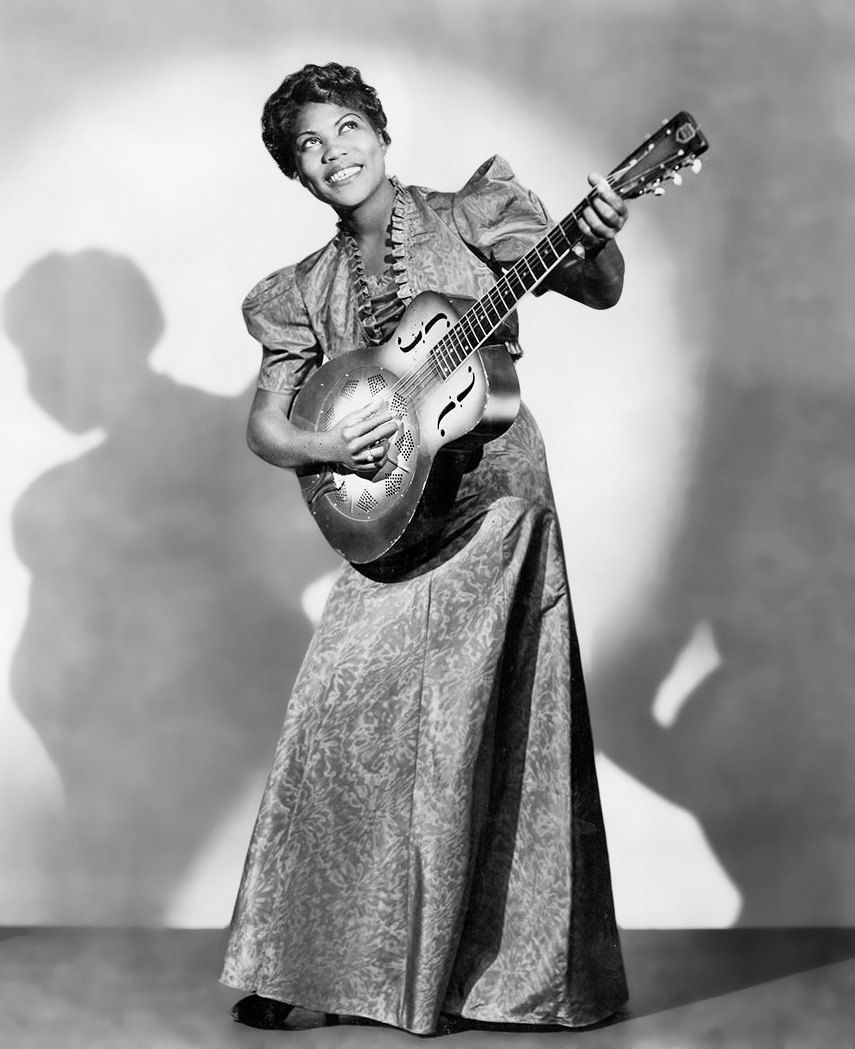
Sister RosettaTharpe
The Godmother of Rock and Roll, who electrified gospel
Sister Rosetta Tharpe
The Godmother of Rock and Roll, who electrified gospel
Rosetta Nubin was born in Cotton Plant, Arkansas, and was performing almost as soon as she could hold a guitar. Her mother, Katie Bell Nubin, was a singer, mandolinist and traveling evangelist in the Church of God in Christ, a Pentecostal denomination that welcomed rhythm, dancing and instruments in worship. As a small child Rosetta toured with her mother across the South, amazing congregations with her voice and guitar. The pair eventually settled in Chicago, where she continued to develop as a church performer.
In 1934 she married preacher Thomas Thorpe, and a variant of his surname became her stage name. By 1938 she had moved to New York, signed with Decca and recorded Rock Me, That's All and The Lonesome Road, gospel songs delivered with swinging rhythm and sharp guitar. She sang at the Cotton Club and appeared in the From Spirituals to Swing concert at Carnegie Hall. Crossing between church and nightclub made her a star but also drew criticism from some in the religious community who felt she was blurring sacred and secular.
During the early 1940s she worked with Lucky Millinder's orchestra, and in 1944 she cut Strange Things Happening Every Day with pianist Sammy Price, a record whose driving beat and stinging electric guitar reached the race records top ten and is often cited as a forerunner of rock and roll. In the late 1940s she formed a hugely popular duo with singer Marie Knight, scoring with Up Above My Head. In 1951 she staged her own wedding as a concert at Washington's Griffith Stadium before a paying crowd of many thousands.
As rhythm and blues and rock and roll displaced her in the American market, she found eager audiences in Europe, touring Britain in 1957 and returning in 1964 with the Blues and Gospel Caravan, when a televised performance on a disused Manchester railway platform inspired a generation of British musicians. A stroke in 1970 and complications from diabetes, including a leg amputation, curtailed her career. She died in Philadelphia in 1973, and decades later the Rock and Roll Hall of Fame inducted her in 2018.
The 10 greatest Sister Rosetta Tharpe solos
- 1Sister Rosetta Tharpe · solo by Sister Rosetta Tharpe · 1944
- 2Sister Rosetta Tharpe · solo by Sister Rosetta Tharpe · 1948
- 3Rosetta Tharpe and Marie Knight · solo by Sister Rosetta Tharpe · 1947
- 4Sister Rosetta Tharpe · solo by Sister Rosetta Tharpe · 1938
- 5Sister Rosetta Tharpe · solo by Sister Rosetta Tharpe · 1938
- 6Sister Rosetta Tharpe · solo by Sister Rosetta Tharpe · 1939
- 7Sister Rosetta Tharpe · solo by Sister Rosetta Tharpe · 1948
- 8Lucky Millinder and His Orchestra · solo by Sister Rosetta Tharpe · 1941
- 9Sister Rosetta Tharpe · solo by Sister Rosetta Tharpe · 1938
- 10Sister Rosetta Tharpe · solo by Sister Rosetta Tharpe · 1938
The sound
Tharpe played with the fervor of a Pentecostal preacher and the swing of a big-band soloist. Her lines mix fingerpicked gospel patterns with bent, blues-inflected single notes, fast repeated figures and slashing chord accents. She was one of the first stars to push an electric guitar to a gritty, overdriven edge, and her solos erupt mid-song with showmanship and joy. Rhythm is everything: even alone she lays down a propulsive beat, and her playing often answers her own powerful vocals in call-and-response.
- Acoustic archtop guitar (guitar) Carried her early church performances and first Decca sessions in the late 1930s.
- Electric hollowbody archtop (guitar) Amplified guitars gave her 1940s records their cutting, stinging lead tone.
- Gibson SG Custom (guitar) The white three-pickup model she famously played during her 1960s European tours, including Manchester in 1964.
- Tube combo amplifier (amp) Driven hard to produce the gritty, raw sound that anticipates rock guitar.
- Natural amplifier overdrive (effect) She let her amps break up at volume long before distortion was fashionable.
Covers
- Rock Me, originally by Thomas A. Dorsey She adapted Dorsey's gospel song Hide Me in Thy Bosom into a swinging showcase.
- The Lonesome Road, originally by Gene Austin She transformed a pop standard into a gospel-blues lament.
- Down by the Riverside, originally by Traditional spiritual Her rhythmic drive turned an old spiritual into a celebratory anthem.
- Didn't It Rain, originally by Traditional spiritual Performed in the rain on a railway platform, it became her most famous filmed moment.
- This Train, originally by Traditional spiritual Her swinging arrangement became a template for later folk revival versions.
Timeline
- 1915 Born Rosetta Nubin in Cotton Plant, Arkansas
- 1934 Marries preacher Thomas Thorpe, source of her stage surname
- 1938 Signs with Decca, plays the Cotton Club and Carnegie Hall
- 1944 Records Strange Things Happening Every Day
- 1946 Begins her popular partnership with Marie Knight
- 1951 Stages her wedding as a concert at Griffith Stadium
- 1957 First British tour
- 1964 Televised Blues and Gospel Caravan performance in Manchester
- 1973 Dies in Philadelphia
- 2018 Inducted into the Rock and Roll Hall of Fame
Facts
- She was performing publicly with her mother by around age four.
- Her stage name comes from her first husband, Thomas Thorpe, with a slight spelling change.
- Strange Things Happening Every Day reached the Billboard race records top ten, rare for a gospel record.
- She invited a teenage Little Richard onstage at a Macon concert in the 1940s after hearing him sing.
- Johnny Cash often named her as one of his favorite performers.
- Her Griffith Stadium wedding drew a paying crowd estimated in the tens of thousands.
- Her 1964 Manchester performance took place on a disused railway station platform in the rain.
- The US Postal Service issued a stamp in her honor in 1998.
- Her grave went without a headstone until admirers raised funds for one in 2008.
- Her recording of Down by the Riverside was added to the National Recording Registry in 2004.