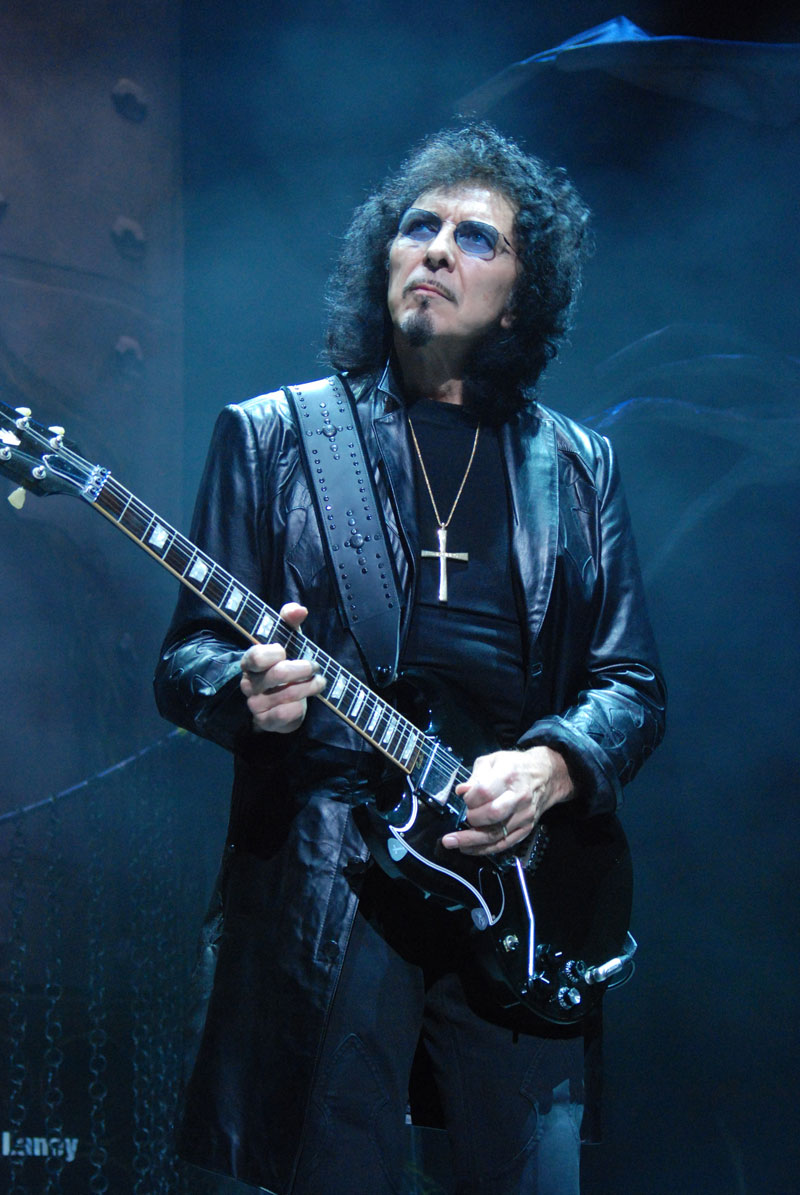
TonyIommi
The riff master who forged heavy metal from injury and invention
Tony Iommi
The riff master who forged heavy metal from injury and invention
Tony Iommi was born in Birmingham to parents of Italian heritage and grew up in the city's industrial heartland. Inspired by Hank Marvin and the Shadows, he began playing in local groups in his mid-teens. At seventeen, an accident with a machine at a sheet-metal factory severed the tips of two fingers on his right hand, his fretting hand as a left-handed player. Encouraged by the example of Django Reinhardt, who played brilliantly with two usable fingers, he refused to give up and devised homemade thimbles to keep playing.
After spells in bands including the Rockin' Chevrolets and The Rest, where he met drummer Bill Ward, Iommi formed a blues group with Ward, bassist Geezer Butler and singer Ozzy Osbourne. In late 1968 he briefly left to join Jethro Tull, appearing with them in the Rolling Stones' Rock and Roll Circus film, but soon returned. The band, first called Earth, became Black Sabbath in 1969 and released their debut album in February 1970, followed later that year by Paranoid.
Throughout the 1970s, Iommi's colossal, doom-laden riffs defined a new genre. On Master of Reality (1971) he tuned his guitar down to ease the strain on his damaged fingers, inadvertently darkening the sound even further. After Osbourne's departure, Ronnie James Dio joined for Heaven and Hell in 1980, reviving the band. Through the decades that followed Iommi remained Sabbath's one constant, steering a long run of singers and lineups while keeping the name and the riffs alive.
The original lineup reunited at Live Aid in 1985 and more lastingly from 1997. Iommi also toured and recorded with Dio, Butler and Vinny Appice under the name Heaven & Hell from 2006. Sabbath's album 13, produced by Rick Rubin, arrived in 2013, and the band played its final tour show in Birmingham in early 2017. In July 2025 the original four reunited once more for the farewell concert Back to the Beginning at Villa Park, weeks before Osbourne's death.
The 10 greatest Tony Iommi solos
- 1Black Sabbath · solo by Tony Iommi · 1970
- 2Black Sabbath · solo by Tony Iommi · 1980
- 3Black Sabbath · solo by Tony Iommi · 1970
- 4Black Sabbath · solo by Tony Iommi · 1970
- 5Black Sabbath · solo by Tony Iommi · 1980
- 6Black Sabbath · solo by Tony Iommi · 1971
- 7Black Sabbath · solo by Tony Iommi · 1970
- 8Black Sabbath · solo by Tony Iommi · 1972
- 9Black Sabbath · solo by Tony Iommi · 1970
- 10Black Sabbath · solo by Tony Iommi · 1973
The sound
Iommi is the architect of the heavy riff. His playing rests on slow, menacing power chords and single-note figures built around the tritone and minor modes, delivered with crushing sustain. Because of his injury he uses prosthetic fingertips and light strings, and from the early 1970s he detuned his guitar, sometimes by up to three semitones, which gave Sabbath its sludgy weight. His solos draw on blues and jazz phrasing, with fast pentatonic bursts, wah-inflected cries and dramatic vibrato, but his true genius lies in writing riffs so elemental they feel as if they always existed.
- Gibson SG "Monkey" (guitar) His 1965 SG Special, the main guitar of Sabbath's early records, later displayed at the Hard Rock Cafe in New York.
- Jaydee custom SGs (guitar) Handmade by John Diggins in the late 1970s with extended fret access for his lead work.
- Fender Stratocaster (guitar) Briefly his main guitar until its pickup failed during the first album sessions, forcing a switch back to the SG.
- Laney Supergroup (amp) The Birmingham-made amp behind his tone from 1968 through the 1970s.
- Laney Tony Iommi signature heads (amp) His signature Laney models became his main amps from the 1990s onward.
- Dallas Rangemaster treble booster (effect) Drove his amps into the thick, saturated tone of the early records.
- Tycobrahe wah pedal (effect) Added vocal expressiveness to his solos.
Covers
- Evil Woman, originally by Crow A commercial cover recorded at their manager's urging, toughened up with his heavy tone.
- Warning, originally by The Aynsley Dunbar Retaliation A blues number stretched into a lengthy jam that shows his roots.
- A Song for Jeffrey, originally by Jethro Tull During his brief Jethro Tull stint he mimed the guitar part to the record for the film.
- Pinball Wizard, originally by The Who He joined Queen's surviving members for a brief, heavy snippet at Wembley.
- I Want It All, originally by Queen Iommi added weight to Queen's anthem with Roger Daltrey on vocals.
- Stone Cold Crazy, originally by Queen Paired with James Hetfield, he helped turn Queen's proto-thrash song into a metal summit.
Timeline
- 1948 Born in Birmingham, England
- 1965 Loses two fingertips in a factory accident at seventeen
- 1968 Brief stint in Jethro Tull; returns to form Earth
- 1969 Earth becomes Black Sabbath
- 1970 Releases Black Sabbath and Paranoid
- 1971 Detuned guitars on Master of Reality
- 1980 Heaven and Hell with Ronnie James Dio
- 2006 Forms Heaven & Hell with the Dio-era lineup
- 2013 Sabbath release 13, produced by Rick Rubin
- 2025 Farewell show Back to the Beginning at Villa Park
Facts
- He made his first fingertip covers by melting a washing-up liquid bottle and topping it with leather.
- Before light-gauge guitar strings were widely available, he used banjo strings to reduce the tension.
- He is left-handed, so the accident damaged his fretting hand.
- He played with Jethro Tull for only a few weeks in 1968.
- In the Rock and Roll Circus footage he is miming to a guitar part recorded by Mick Abrahams.
- His famous SG was nicknamed Monkey because of a sticker on it.
- He is the only member to appear on every Black Sabbath album.
- He was made a Freeman of the City of Birmingham in 2017.
- He performed at both the opening and closing ceremonies of the 2022 Commonwealth Games in Birmingham.
- He collaborated with the Birmingham Royal Ballet on Black Sabbath – The Ballet in 2023.